That’s How Children Become “Man and Woman”!

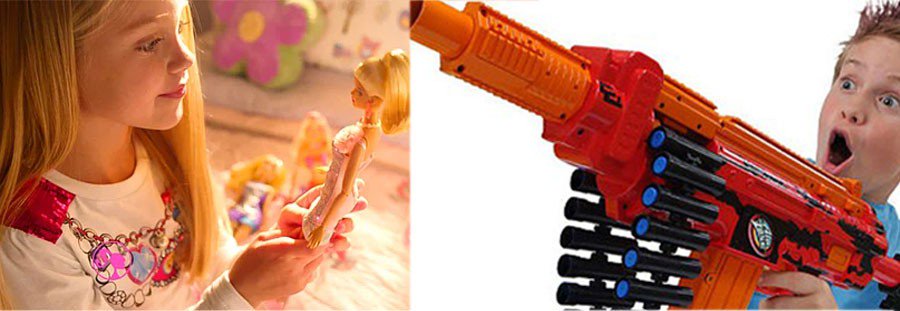
Gender roles settle in very early ages but how do these roles affect children’s toy preferences? EsraDalçiçek looks for the answer to this question in her thesis. Her thesis aims to examine preschool children’s toy preferences in the context of society-culture and gender. Dalçiçek observed 16 children in a preschool education class for almost a year.
16 March 2018
Some notes from her thesis:
Children are placed in a certain kind of order by educators and parents. Then, they create some codes for themselves with a reference from their parents’ behaviours and they learn everything from their toys. However, toys are not the only factor. Toys give a message to them about how to get dressed, how to behave and how many children to give birth in the future. When playing, children usually use a tale-like language and behave like a miniature adult. They observe adults and impersonate their behaviours.
Girls usually create private zones as small circles. They don’t use the playgrounds widely, they are mostly quiet. Boys, on the other hand, are constantly moving. Their communication period is more active and they are speaking louder.
Although the teacher has never made that kind of distinction, playgrounds are separated as “girl and boy zone”. For example, children regard theatrical playground, art, book and music centres as “girl zones” while the block and science centre are regarded as “boy zones”.
Generally, mothers represent inner space while the fathers represent public space. House works are attributed to mothers; that’s why, theatrical playground which has items like dust cloth, toy cleaning products, and sofas is preferred mostly by girls. Block centre which has toys like blocks, cars are preferred by boys.
Children share occupations among themselves and boys are assigned to mechanic works, while girls get the more fragile and easier occupations.
What should be done to children be “children”?
“Both sexes should be given toys like babies or cars. Girls should also be given toys like blocks, garden equipment and so on… They should never be given toy guns. They should not be grown in a violent environment. If elders at home use guns, the child already will see cognitive codes of that in them. They can easily legitimize it. Although it seems simple, it is kind of scary. She or he can have an interest for guns in the future. It is easier to manage a behaviour developed in adulthood than in childhood. We should all struggle hard to raise more optimistic children.”
Bizi Takip Edin